
Difference Between Hashing and Salting for Secure Password Storage
Salting prevents attackers from using precomputed rainbow tables to reverse hashed passwords, adding a unique random value to each input before processing.
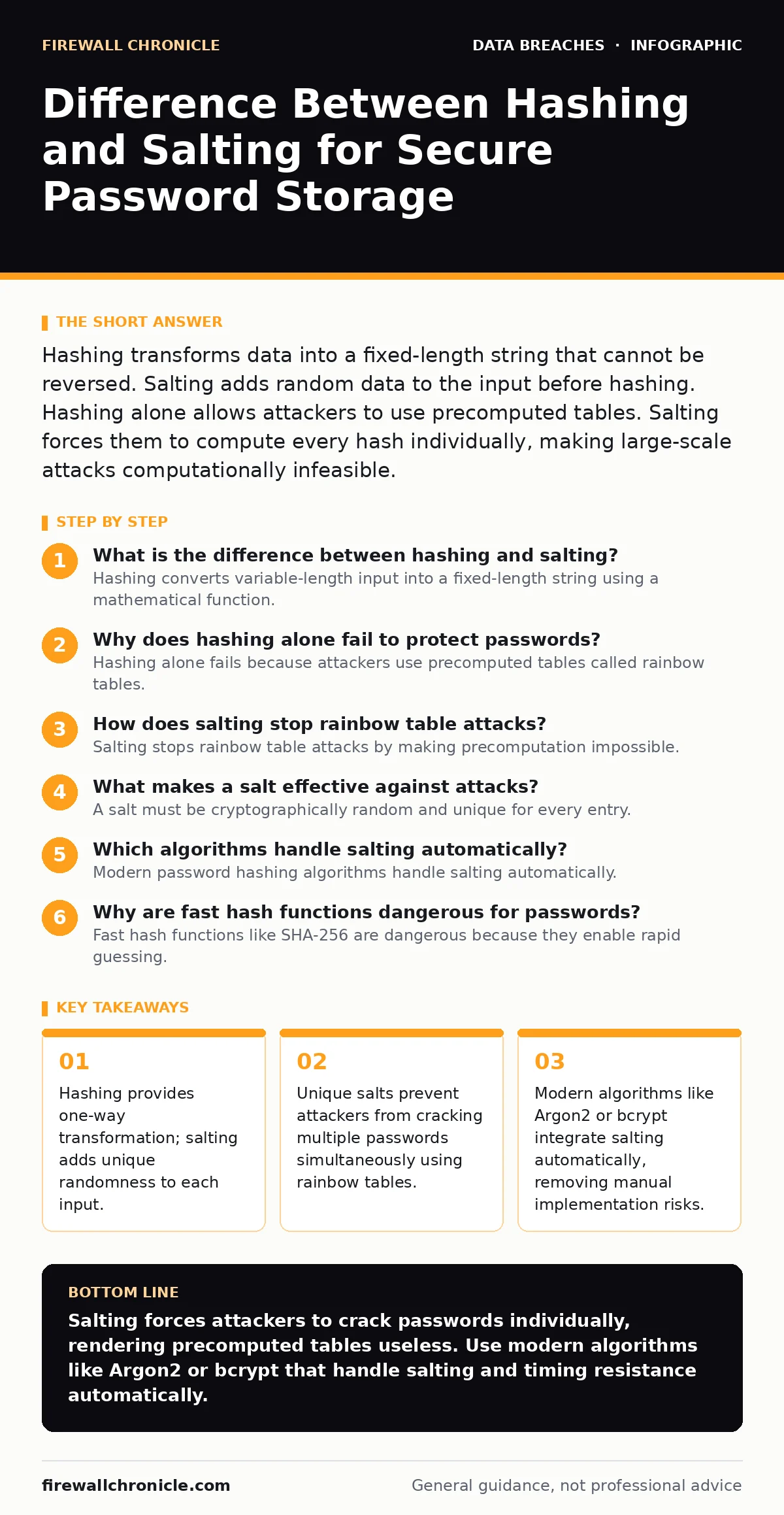
Hashing transforms data into a fixed-length string that cannot be reversed. Salting adds random data to the input before hashing. Hashing alone allows attackers to use precomputed tables. Salting forces them to compute every hash individually, making large-scale attacks computationally infeasible.
What is the difference between hashing and salting?
Hashing converts variable-length input into a fixed-length string using a mathematical function. Salting appends a random string to the input before that function runs. The difference lies in their purpose: hashing ensures integrity and non-reversibility, while salting ensures uniqueness. Without salting, identical passwords produce identical hashes. Attackers exploit this similarity to crack many accounts at once. Salting breaks this pattern by ensuring no two hashes match, even for identical passwords.
Why does hashing alone fail to protect passwords?
Hashing alone fails because attackers use precomputed tables called rainbow tables. These tables map common passwords to their hash values. If you store unsalted hashes, an attacker compares your database against their table. A match reveals the password instantly. This method requires no computing power during the attack, only storage. The cost of generating these tables is amortized over millions of potential victims. Your system becomes vulnerable to instant, massive credential theft without any complex computation.
How does salting stop rainbow table attacks?
Salting stops rainbow table attacks by making precomputation impossible. Each user receives a unique salt. This salt combines with the password before hashing. The resulting hash depends on both the password and the specific salt. An attacker cannot use a single precomputed table for your entire database. They must generate a new table for every single user. This multiplies the computational cost by the number of users. The attack shifts from a lookup operation to a brute-force effort for each account.
What makes a salt effective against attacks?
A salt must be cryptographically random and unique for every entry. Reusing salts across users defeats the purpose. If two users share a salt, their hashes remain comparable. An attacker can still use batch cracking techniques on those specific accounts. The salt length should match the hash output size to maximize entropy. Storing the salt alongside the hash is standard practice. The salt is not secret; its value lies in uniqueness. Predictable salts, like user IDs or timestamps, provide no security benefit.
Which algorithms handle salting automatically?
Modern password hashing algorithms handle salting automatically. Algorithms like bcrypt, scrypt, and Argon2 generate a random salt internally. They embed the salt and configuration parameters into the final hash string. This eliminates the risk of manual implementation errors. Developers do not need to manage salt storage or generation. Using these algorithms ensures industry-standard security without custom code. Older algorithms like MD5 or SHA-256 require manual salting. Manual implementation often leads to subtle bugs that compromise security.
| Algorithm | Auto-Salt | Memory Hard | Speed |
|---|---|---|---|
| bcrypt | Yes | No | Slow |
| scrypt | Yes | Yes | Slow |
| Argon2 | Yes | Yes | Slow |
| SHA-256 | No | No | Fast |
See also: Encrypting Data at Rest for Small Teams: Practical Steps · Data Encryption in Transit: Protecting Moving Information
Why are fast hash functions dangerous for passwords?
Fast hash functions like SHA-256 are dangerous because they enable rapid guessing. Attackers use specialized hardware to test billions of passwords per second. Fast functions provide no resistance to this speed. Password hashing must be slow to increase the cost of each guess. Algorithms like bcrypt intentionally add computational overhead. This slows down attackers while having a negligible impact on user login times. Speed is the enemy of password security. You want the server to work hard, not the attacker.
What is the hidden cost of manual salt management?
The hidden cost of manual salt management is implementation complexity. Developers must generate, store, and retrieve salts correctly. A single bug in the storage layer can expose salts. If salts are stored separately from hashes, synchronization issues arise. If salts are lost, passwords cannot be verified. Manual systems often lead to inconsistent salt lengths or reuse. These errors create false confidence. The system appears secure but fails under targeted attack. Automated algorithms remove this operational burden entirely.
How does salting relate to broader security practices?
Salting protects stored credentials, but it does not prevent all breaches. You must combine it with role-based access control to limit data exposure. If an attacker gains access, they should not reach all password hashes. File integrity monitoring can detect unauthorized changes to the database. Incident communication plans ensure you notify users if hashes are exposed. Customer breach notification letters must explain the risk clearly. Salting is one layer in a defense-in-depth strategy. It reduces impact but does not eliminate the need for other controls.
What happens if an attacker steals the database?
If an attacker steals the database, they obtain the hashes and salts. They cannot reverse the hashes to get passwords. They must attempt to guess passwords for each user individually. This process is slow and expensive. Many users have weak passwords that fall quickly. However, strong, unique passwords remain secure for years. The attacker must balance cost against reward. Salting ensures they cannot crack low-hanging fruit instantly. It forces them to invest significant resources for partial success.
How do you verify a password correctly?
Verification requires retrieving the stored hash and salt. You combine the new password with the stored salt. You run the same hashing algorithm. You compare the new hash with the stored hash. If they match, the password is correct. This process must be identical to storage. Any deviation causes login failures. The algorithm parameters must also match. Modern libraries handle this comparison securely. They prevent timing attacks that reveal information about the hash. Consistency is key to functional security.
Key takeaways
- Hashing provides one-way transformation; salting adds unique randomness to each input.
- Unique salts prevent attackers from cracking multiple passwords simultaneously using rainbow tables.
- Modern algorithms like Argon2 or bcrypt integrate salting automatically, removing manual implementation risks.
Salting forces attackers to crack passwords individually, rendering precomputed tables useless. Use modern algorithms like Argon2 or bcrypt that handle salting and timing resistance automatically.
Frequently asked questions
Can I use a global salt for all users?
No. A global salt is effectively no salt at all. It allows attackers to use precomputed tables against your entire user base simultaneously. Uniqueness is the core requirement.
Is the salt considered secret data?
No. The salt is stored publicly alongside the hash. Its security value comes from being unique and random, not from being hidden. Treating it as secret adds unnecessary complexity.
Should I hash passwords on the client side?
No. Client-side hashing exposes the hash to network interception. Attackers can use the hash as the password. Server-side hashing with salting is the only secure method.
Does salting protect against phishing?
No. Salting only protects stored data. If a user types their password into a fake site, salting provides no protection. Users must verify URLs and use multi-factor authentication.
How this guide was produced: written by the Firewall Chronicle editorial team with AI assistance, checked against the public references listed below, and reviewed when the facts change. See our editorial policy or report an error.