
Cloud Migration Security for Small Teams: Low-Cost Controls
Small teams face disproportionate risk during cloud migration because default configurations often expose data before security policies are finalized.
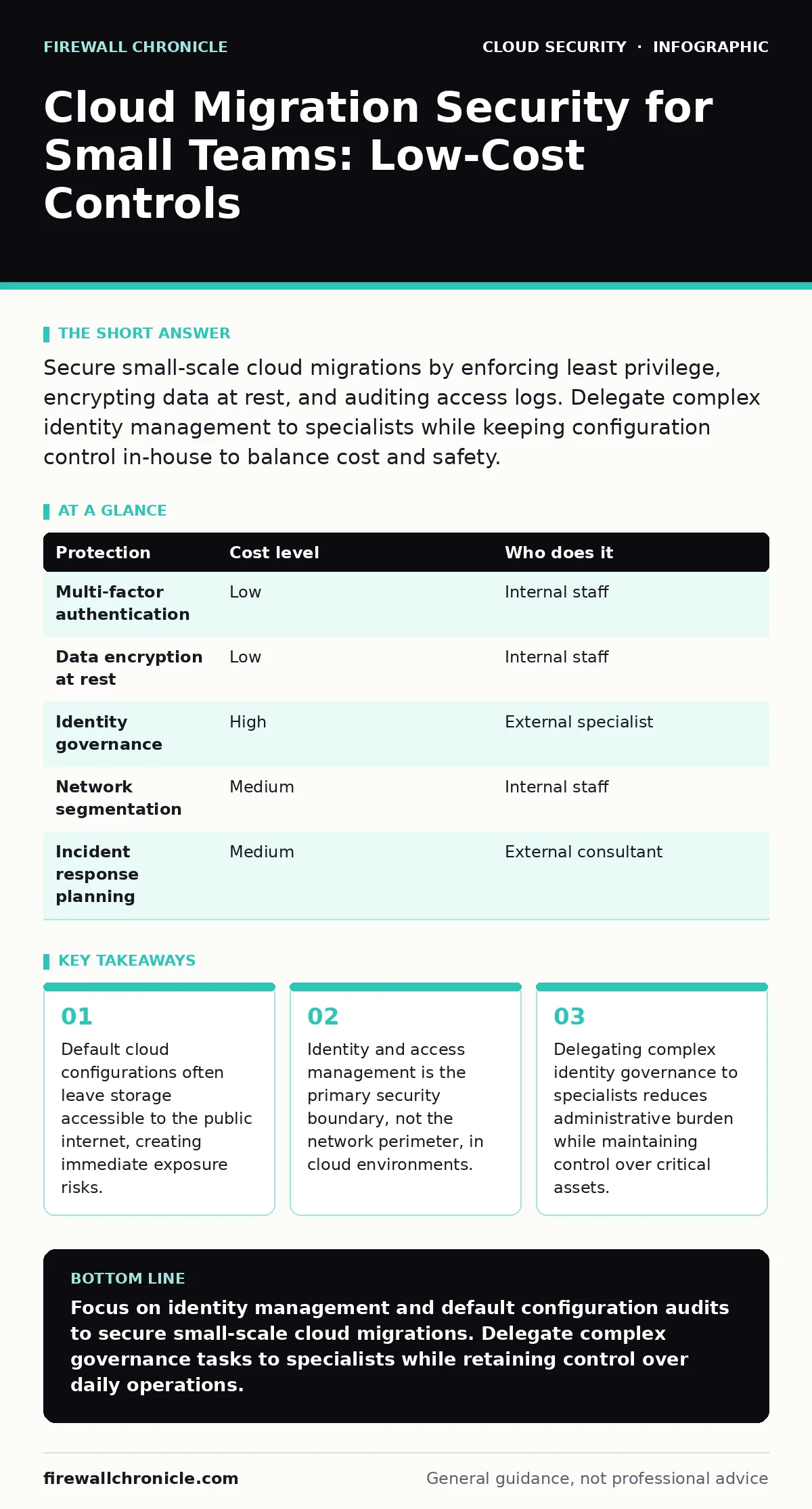
Secure small-scale cloud migrations by enforcing least privilege, encrypting data at rest, and auditing access logs. Delegate complex identity management to specialists while keeping configuration control in-house to balance cost and safety.
The Scale of Exposure
Moving to the cloud changes how attackers find targets. In on-premises environments, attackers must breach a physical perimeter or scan for open ports. In the cloud, attackers scan for misconfigured resources. A small team lacks the depth of staff to monitor these resources continuously. This creates a window of vulnerability where data is live but unprotected.
The risk is not proportional to the size of the company. A ten-person firm may hold intellectual property as valuable as a large corporation. Attackers automate their scanning tools. They do not care about company size. They care about exposed data.
Default Configurations Are Dangerous
Cloud providers offer convenience by default. This convenience often means open access. Storage buckets, databases, and compute instances often launch with permissions that allow broad access. This is known as the principle of least privilege violation. The principle of least privilege means granting only the permissions necessary to perform a task.
When you migrate, you must audit every resource. Check who can read, write, or execute code. Do not assume the provider secures your data by default. The provider secures the infrastructure. You secure what you put on it.
Identity Is the New Perimeter
Traditional firewalls protect the network edge. In the cloud, the network is virtual and dynamic. The real boundary is identity. Identity and access management (IAM) controls who can do what. If an attacker compromises a user account, they bypass network defenses.
You must enforce multi-factor authentication (MFA). MFA requires a second form of verification, such as a code from a phone app. This stops attackers who have stolen passwords. You should also review access keys. Access keys are credentials used by applications to authenticate. Old keys often remain active after employees leave or projects end.
Consider implementing single sign-on to centralize identity management. This reduces the number of passwords users must manage and allows for centralized revocation. For deeper access control within containerized environments, review guides on Kubernetes RBAC to understand role-based permissions.
Cost-Effective Security Controls
Small businesses often believe security requires expensive tools. This is incorrect. Many security controls are built into cloud platforms. You pay for what you use. Basic logging and encryption are often low-cost or free.
Encrypt all data at rest. Data at rest is data stored on disks or in databases. Encryption turns readable data into scrambled text. Only those with the key can read it. Most cloud providers offer server-side encryption by default. Ensure this is enabled for all storage.
Enable activity logging. Logs record who accessed what and when. You do not need to read logs manually. Set up alerts for suspicious activity, such as logins from unusual locations. This provides visibility without constant monitoring.
| Protection | Cost level | Who does it |
|---|---|---|
| Multi-factor authentication | Low | Internal staff |
| Data encryption at rest | Low | Internal staff |
| Identity governance | High | External specialist |
| Network segmentation | Medium | Internal staff |
| Incident response planning | Medium | External consultant |
What to Delegate
You cannot do everything. Small teams lack the bandwidth to manage complex security tasks. Delegating certain functions to specialists is wise. This is not outsourcing security. It is leveraging expertise.
Delegate identity governance. Managing user permissions at scale is complex. Specialists can audit permissions and remove excess access. They can also set up automated workflows for onboarding and offboarding.
Delegate incident response planning. You need a plan for when things go wrong. Specialists can create a playbook tailored to your cloud environment. This includes steps for isolating compromised resources and notifying stakeholders.
Do not delegate configuration control. You must understand your own environment. If you outsource everything, you lose visibility. You become dependent on the vendor. This creates new risks.
See also: Multi Cloud Security Challenges: How to Stop Config Drift · Cloud Ransomware: How Attacks Bypass Traditional Perimeters
Network Segmentation for Small Teams
Even small teams should segment their network. Network segmentation divides your cloud environment into smaller zones. If an attacker breaches one zone, they cannot easily move to others. This limits the blast radius.
Use virtual private clouds (VPCs) to create isolated networks. Place sensitive data in a private subnet. A private subnet has no direct internet access. Only authorized services can communicate with it.
This approach aligns with cloud network segmentation best practices. It adds a layer of defense without significant cost. It requires careful planning. You must define which services need to talk to each other. Document these dependencies before migration.
Auditing and Continuous Improvement
Security is not a one-time task. It is a continuous process. You must audit your environment regularly. Check for new vulnerabilities and misconfigurations. Use automated tools to scan for issues.
Review access logs monthly. Look for patterns. Are there logins at odd hours? Are there failed login attempts? These may indicate an attack. Investigate and adjust controls as needed.
Stay informed about new threats. Attackers constantly change their tactics. New vulnerabilities emerge regularly. Subscribe to security advisories from your cloud provider. Apply patches promptly.
Conclusion of Strategy
Small businesses can achieve strong security in the cloud. It requires discipline and focus. Prioritize identity management and encryption. Delegate complex tasks to specialists. Maintain control over configuration and auditing.
By following these steps, you reduce risk without breaking the bank. You protect your data and your reputation. Security is an investment, not a cost. It enables growth and trust.
Key takeaways
- Default cloud configurations often leave storage accessible to the public internet, creating immediate exposure risks.
- Identity and access management is the primary security boundary, not the network perimeter, in cloud environments.
- Delegating complex identity governance to specialists reduces administrative burden while maintaining control over critical assets.
Focus on identity management and default configuration audits to secure small-scale cloud migrations. Delegate complex governance tasks to specialists while retaining control over daily operations.
Frequently asked questions
How do I know if my cloud storage is exposed?
Check the access permissions on your storage buckets. If they allow public read or write access, they are exposed. Use your provider’s security scanner to identify these issues.
Is multi-factor authentication enough?
MFA is critical but not sufficient. You must also enforce least privilege, encrypt data, and monitor logs. MFA protects accounts, not necessarily misconfigured resources.
Should I hire a security consultant?
Consider hiring a consultant for initial setup and periodic audits. They can identify gaps you might miss. However, keep day-to-day management in-house to maintain visibility.
What is the first step in cloud migration security?
Define your data classification. Identify what data is sensitive. This determines the level of protection required. Do not migrate all data with the same security level.
How this guide was produced: written by the Firewall Chronicle editorial team with AI assistance, checked against the public references listed below, and reviewed when the facts change. See our editorial policy or report an error.