IDS vs IPS: Which Security Control Fits Your Architecture?
Inline intrusion prevention alters traffic flow and introduces latency, while passive detection preserves performance at the cost of delayed response.
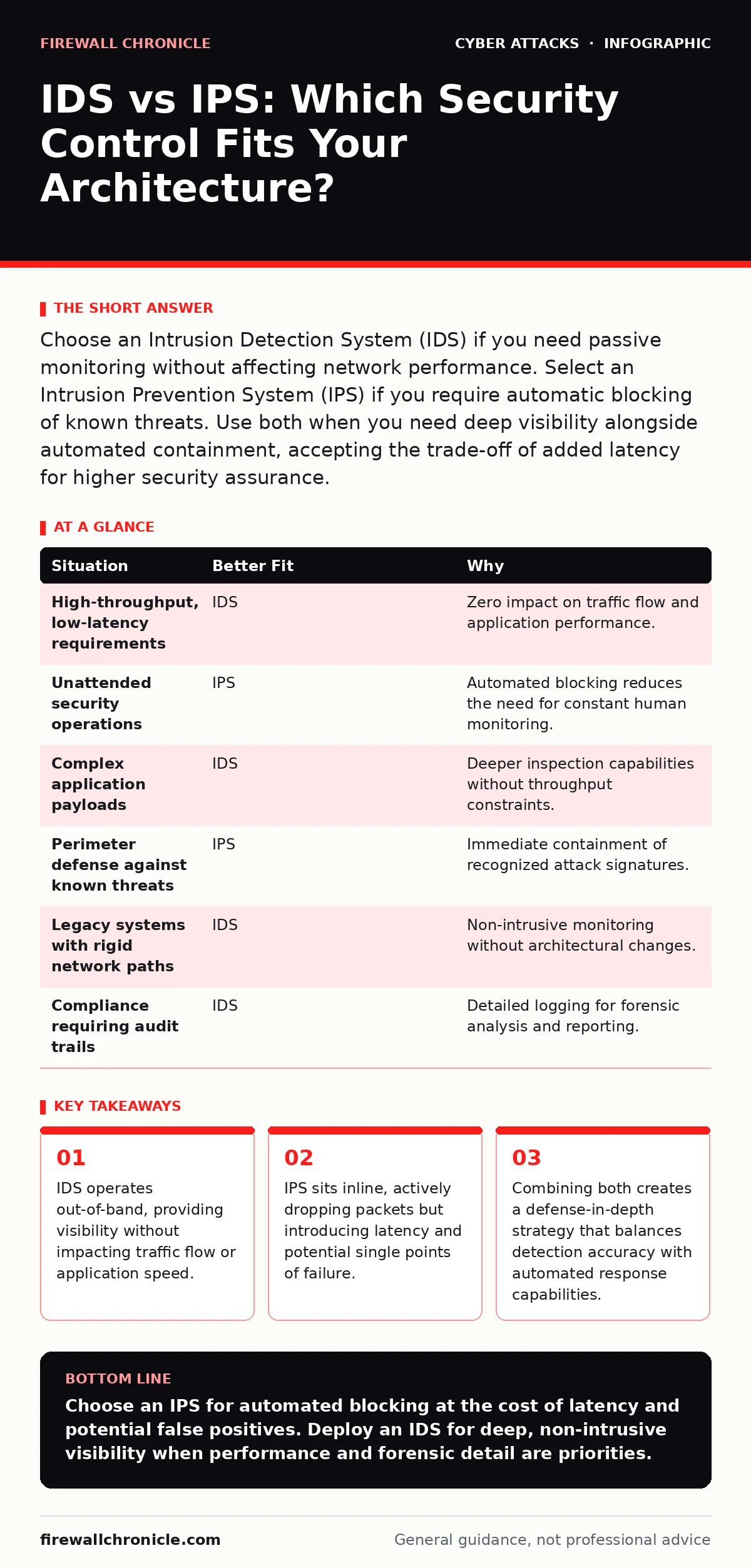
Choose an Intrusion Detection System (IDS) if you need passive monitoring without affecting network performance. Select an Intrusion Prevention System (IPS) if you require automatic blocking of known threats. Use both when you need deep visibility alongside automated containment, accepting the trade-off of added latency for higher security assurance.
Does Your Application Tolerate Added Latency?
Network performance dictates the first layer of your decision. An Intrusion Prevention System (IPS) sits directly in the path of network traffic. It inspects every packet before allowing it to pass to its destination. This inline position means the IPS adds processing time to every connection.
An Intrusion Detection System (IDS) operates out-of-band. It receives a copy of the traffic via a network tap or port mirroring. The original traffic flows to its destination regardless of what the IDS sees. This architecture introduces zero latency to the live connection.
Imagine a high-frequency trading platform where microseconds determine profit margins. An inline IPS could disrupt order execution by adding even minimal processing delay. In this scenario, the cost of a brief delay outweighs the benefit of automated blocking. You would choose an IDS to monitor for anomalies without interfering with the critical data path.
Is Automated Blocking Worth the Risk of False Positives?
Automated response carries the burden of accuracy. An IPS automatically drops packets or resets connections when it identifies a threat signature. This happens in milliseconds, without human intervention. However, signature-based detection is prone to false positives. Legitimate traffic that resembles a known attack pattern will be blocked.
Consider a software deployment pipeline that sends unusual payloads for testing. An IPS might interpret these test payloads as malicious code and block the deployment. The result is a halted development cycle and frustrated engineers. You must weigh the convenience of automated blocking against the operational friction of managing false alarms.
An IDS generates alerts but does not block traffic. It requires a security team to investigate and act. This manual step introduces delay but prevents accidental disruption of legitimate business processes. If your team lacks the bandwidth to investigate alerts in real-time, an IDS may become a passive log generator rather than an active security tool.
Do You Need Deep Forensic Visibility?
Detection capabilities differ between the two systems. An IDS often performs deeper inspection because it is not constrained by the need to forward traffic quickly. It can reconstruct sessions, analyze full packet payloads, and correlate events across multiple streams. This depth aids in forensic analysis after an incident occurs.
An IPS must make decisions rapidly. It often relies on quicker, less thorough inspection methods to maintain throughput. While modern IPS engines are powerful, the pressure to forward packets can limit the depth of analysis. You might miss subtle, slow-moving attacks that require correlating data over a longer period.
If your primary goal is to understand how an attacker moved through your network, an IDS provides richer data. It allows you to see the entire context of an attack without the IPS having already dropped the malicious packets. This visibility is vital for post-incident reviews and improving your security posture.
How Does Network Topology Influence Your Choice?
The physical or virtual placement of your security controls matters. An IPS requires a specific placement in the network path. It must be positioned between the source and destination of traffic. This limits where you can deploy it, especially in complex virtualized environments.
An IDS can be placed anywhere you can mirror traffic. You can monitor internal segments, perimeter boundaries, and cloud interfaces simultaneously. This flexibility allows you to gain visibility into parts of the network that are difficult to place inline controls.
Suppose you have a legacy application that cannot tolerate any change in its network path. You cannot insert an IPS without refactoring the application’s network configuration. An IDS allows you to monitor this legacy system without altering its architecture. This non-intrusive monitoring is often the only viable option for rigid legacy environments.
Situation Comparison Table
| Situation | Better Fit | Why |
|---|---|---|
| High-throughput, low-latency requirements | IDS | Zero impact on traffic flow and application performance. |
| Unattended security operations | IPS | Automated blocking reduces the need for constant human monitoring. |
| Complex application payloads | IDS | Deeper inspection capabilities without throughput constraints. |
| Perimeter defense against known threats | IPS | Immediate containment of recognized attack signatures. |
| Legacy systems with rigid network paths | IDS | Non-intrusive monitoring without architectural changes. |
| Compliance requiring audit trails | IDS | Detailed logging for forensic analysis and reporting. |
See also: Port Scan Response: Containment, Recovery, and Prevention Steps · VPN Gateway and ADC Vulnerabilities: The Hidden Risks in Network Perimeters
Using IDS and IPS Together
You do not have to choose exclusively between the two. Many organizations deploy both to balance visibility and control. This is known as defense-in-depth. The IPS handles the bulk of known threats at the perimeter, blocking them automatically. The IDS monitors internal traffic and the IPS itself, looking for missed threats or anomalies.
This combination mitigates the weaknesses of each system. The IPS reduces the volume of malicious traffic reaching internal systems. The IDS provides a secondary check and deeper analysis for traffic that passes the IPS. If the IPS fails or is bypassed, the IDS alerts you to the intrusion.
Integrating both systems requires careful tuning. You must ensure that the IDS and IPS do not generate conflicting alerts. Correlating events from both sources helps reduce noise and provides a clearer picture of the security landscape. This integration supports broader strategies like network segmentation, where different zones have tailored security controls.
Key takeaways
- IDS operates out-of-band, providing visibility without impacting traffic flow or application speed.
- IPS sits inline, actively dropping packets but introducing latency and potential single points of failure.
- Combining both creates a defense-in-depth strategy that balances detection accuracy with automated response capabilities.
Choose an IPS for automated blocking at the cost of latency and potential false positives. Deploy an IDS for deep, non-intrusive visibility when performance and forensic detail are priorities.
Frequently asked questions
Can an IDS block malicious traffic?
No, an IDS is purely passive. It monitors and alerts but cannot drop packets or reset connections. You need an IPS or firewall for active blocking.
Is an IPS better than a firewall?
They serve different purposes. A firewall controls traffic based on rules and ports. An IPS inspects packet content for known attack signatures. They complement each other.
How do I reduce false positives in an IPS?
Tune your signatures regularly. Update your threat intelligence feeds. Monitor alerts closely in a staging environment before applying rules to production traffic.
Does an IDS protect against zero-day attacks?
Signature-based IDS and IPS struggle with zero-days. Anomaly-based detection can help but often generates more false positives. Combine with other controls like **man-in-the-middle attacks** prevention and strict access controls.
How this guide was produced: written by the Firewall Chronicle editorial team with AI assistance, checked against the public references listed below, and reviewed when the facts change. See our editorial policy or report an error.