
Attack Surface Reduction Rules: Definition, Mechanics, and Scope
These rules enforce process-level blocking policies that stop known exploit techniques before they execute, shifting defense from signature scanning to behavioral control.
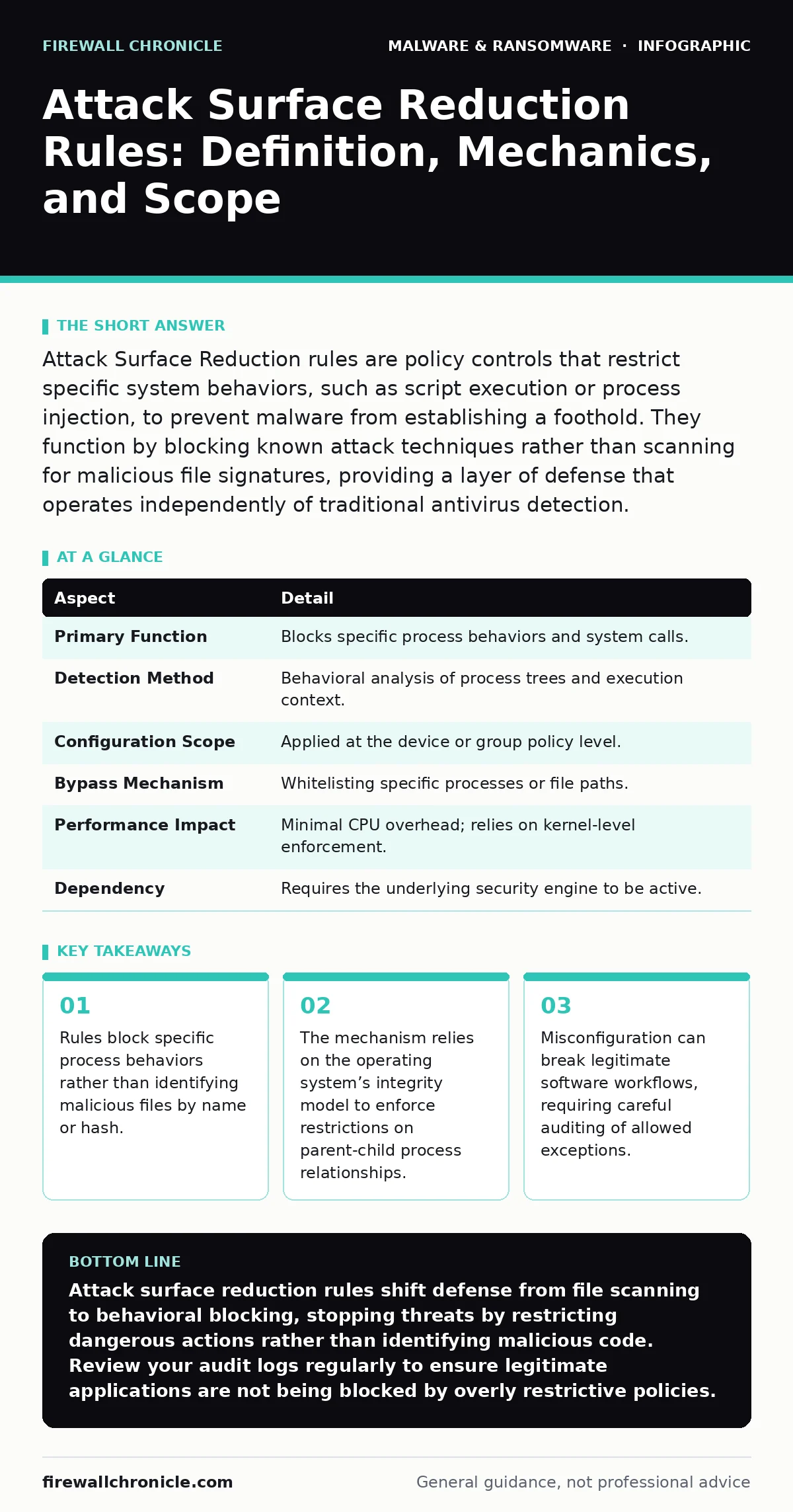
Attack Surface Reduction rules are policy controls that restrict specific system behaviors, such as script execution or process injection, to prevent malware from establishing a foothold. They function by blocking known attack techniques rather than scanning for malicious file signatures, providing a layer of defense that operates independently of traditional antivirus detection.
The Gatekeeper Analogy
Imagine a secure facility that does not check the face of every visitor. Instead, it enforces strict rules about what visitors can do inside. A person might be allowed entry, but they cannot bring in tools, cannot enter the server room, and cannot talk to the maintenance staff. If someone tries to drill into a wall, the system stops them immediately because the action itself is forbidden, regardless of who is doing it.
Attack surface reduction rules work on this same principle. They do not ask if a file is bad. They ask if a specific action is allowed. This shifts the focus from identifying threats to restricting behaviors that attackers rely on to move through a system.
What Is Attack Surface Reduction?
Attack surface reduction (ASR) rules are a set of policy controls within the Microsoft Defender Antivirus framework. They restrict specific system behaviors that are commonly abused by malware, ransomware, and exploit kits. When a rule is enabled, the operating system blocks the action if it violates the policy.
This mechanism differs from traditional antivirus scanning. Traditional scanning looks for known bad files. ASR looks for known bad actions. For example, if a rule blocks scripts from running inside archive files, the system will stop the script even if the archive contains no known malware signatures. This allows the system to stop zero-day attacks that rely on standard exploitation techniques.
| Aspect | Detail |
|---|---|
| Primary Function | Blocks specific process behaviors and system calls. |
| Detection Method | Behavioral analysis of process trees and execution context. |
| Configuration Scope | Applied at the device or group policy level. |
| Bypass Mechanism | Whitelisting specific processes or file paths. |
| Performance Impact | Minimal CPU overhead; relies on kernel-level enforcement. |
| Dependency | Requires the underlying security engine to be active. |
The Problem It Solves
Most malware relies on living off the land. This means attackers use legitimate system tools and features to carry out their attacks. They might use PowerShell to download a payload, or they might inject code into a harmless process like Word or Excel. Traditional antivirus software often fails here because the tools being used are legitimate, and the malicious code may not yet have a known signature.
ASR rules solve this by treating the technique as the threat. If an attacker tries to use a legitimate scripting engine to launch an executable, the rule blocks the execution. This closes the gap between when a threat enters the system and when it causes damage. It forces attackers to find new ways to bypass these restrictions, which increases their effort and reduces their success rate.
Core Components and Mechanics
The system uses a list of predefined rules, each targeting a specific attack technique. These rules are identified by unique identifiers, allowing administrators to enable or disable them individually. The most common rules target script engines, process injection, and obfuscated scripts.
When a process attempts an action, the security engine checks the current ASR configuration. If the action matches a blocked rule, the engine terminates the process and logs the event. The decision is made in real-time. This means the malware never gets a chance to establish persistence or encrypt files.
One critical component is the parent-child process relationship. Many rules examine who launched the current process. If a web browser launches a script, the system treats it differently than if a system administrator launched it manually. This context-awareness allows for finer control over what is permitted.
Integration with Other Defences
ASR rules do not replace other security controls. They work best when layered with other protections. For instance, tamper protection ensures that attackers cannot simply disable the ASR rules once they gain access. Without tamper protection, a privileged attacker could turn off these restrictions and render them useless.
These rules also complement next-generation antivirus solutions. While the antivirus engine scans for known malware, ASR blocks the techniques used by unknown malware. This creates a dual-layer defense. If a threat evades the signature database, it likely triggers a behavioral rule.
It is also relevant to consider browser hijackers and spyware. While ASR is designed for high-impact threats like ransomware, the same behavioral restrictions can stop less sophisticated malware from installing unwanted extensions or tracking software. However, ASR is not a substitute for endpoint detection and response, which provides deeper visibility into system activity.
Common Misconfigurations
The most common mistake is enabling all rules in a production environment without testing. Some legitimate applications rely on the behaviors that ASR rules block. For example, some deployment tools use process injection to update software components. Blocking this behavior can break internal tools.
Administrators often assume that blocking a rule is sufficient. However, attackers can adapt. If a rule blocks a specific script engine, the attacker might use a different engine or a compiled binary. Therefore, rules must be updated as new techniques emerge.
Another error is ignoring the audit mode. Most systems allow you to enable rules in audit mode first. This logs violations without blocking them. Skipping this step leads to immediate disruption. You must review the logs to identify false positives before enforcing the block.
Hidden Costs and Trade-offs
There is a hidden cost to using ASR rules: complexity in troubleshooting. When a legitimate application fails, the error message may be generic. Identifying that an ASR rule caused the failure requires digging into security logs. This adds time to incident response and support tickets.
Additionally, over-reliance on ASR can create a false sense of security. These rules only cover known techniques. If an attacker develops a new method that does not match any existing rule, the system will allow it. ASR is not a silver bullet. It must be part of a broader strategy that includes patch management and user training.
You must also consider the impact on developer workflows. Developers often use scripts and local servers for testing. Strict ASR rules can interfere with these activities. You may need to create specific exclusions for development machines, which introduces a new attack surface if those machines are not properly secured.
What People Usually Get Wrong
Many believe that ASR rules are a replacement for antivirus. This is incorrect. ASR blocks behaviors, but it does not clean up existing infections. If malware is already resident in memory, ASR may not stop it. You still need Microsoft Defender Antivirus or another endpoint protection platform to scan and remove threats.
Another misconception is that ASR rules are static. They are not. Attackers constantly change their tactics. The rules must be updated to reflect new threats. If you set the rules once and forget them, they will become less effective over time.
Finally, some assume that ASR rules prevent all remote code execution. They do not. They prevent specific vectors. If an attacker finds a way to execute code that does not trigger a specific rule, the attack will succeed. This is why defense in depth is necessary.
Key takeaways
- Rules block specific process behaviors rather than identifying malicious files by name or hash.
- The mechanism relies on the operating system’s integrity model to enforce restrictions on parent-child process relationships.
- Misconfiguration can break legitimate software workflows, requiring careful auditing of allowed exceptions.
- These controls complement signature-based detection by stopping threats that evade file-based scanning.
Attack surface reduction rules shift defense from file scanning to behavioral blocking, stopping threats by restricting dangerous actions rather than identifying malicious code. Review your audit logs regularly to ensure legitimate applications are not being blocked by overly restrictive policies.
Frequently asked questions
Do ASR rules slow down my computer?
No, the performance impact is negligible because the rules are enforced at the kernel level and only check specific system calls.
Can malware bypass ASR rules?
Yes, if the malware uses a technique that is not covered by an enabled rule, or if it exploits a vulnerability that allows it to disable the security engine.
How do I know which rules to enable?
Start with audit mode for all rules. Review the logs for false positives. Enable the rules that do not interfere with your legitimate workflows.
How this guide was produced: written by the Firewall Chronicle editorial team with AI assistance, checked against the public references listed below, and reviewed when the facts change. See our editorial policy or report an error.